
How fast is a brisk walk?
On this page
About 100 steps a minute, or 2.5 mph and up. Count your steps for 15 seconds and multiply by 4, and if you get 100 or more, you’re walking briskly. If you can talk but not sing, you’re there too.
“Brisk” sounds vague, so most people guess, and most guess generously. A walk with the dog at 80 steps a minute, stopping at every tree, feels like exercise but sits below the line. Other people think brisk means a power walk with pumping arms. The real line is in between, and you can find it in 15 seconds.
What we’d do
Test it once with the tap counter on Is my walk brisk enough? or by counting your steps for 15 seconds, and pay attention to how that pace feels. After that you won’t need to count. If you struggle to hold it, walk to a beat at 100 to 120 a minute, which the brisk walk in the session player plays for you.
Brisk is how you walk when you’re a few minutes late for a train. You aren’t running, and you aren’t looking in shop windows either.
Where does 100 steps a minute come from?
In 2019, Catrine Tudor-Locke’s team brought 76 healthy adults aged 21 to 40 into a lab, 10 men and 10 women from every 5-year age band. Each person walked on a treadmill for 5 minutes at a time, starting at half a mile an hour and going up by half a mile an hour, while a mask measured how much oxygen they used and someone counted their steps by hand. At 100 steps a minute, people were at moderate effort 91.4% of the time.
The same study set 130 steps a minute as the line for vigorous, but it was right only 70.7% of the time, so at that pace the talk test is the better guide. Everyone in the study was 40 or younger. If you’re older, use the talk test alongside the count, since nobody has shown yet that 100 is the right line at every age.
Your pace, in three ways
| Steps a minute | Steps in 15 seconds | What it counts as |
|---|---|---|
| Under 100 | Under 25 | Light. It helps your health, it doesn’t add to the 150 |
| 100 to 129 | 25 to 32 | Brisk, or moderate. Every minute counts toward the 150 |
| 130 or more | 33 or more | Probably vigorous. Counts double if you can only say a few words |
In miles an hour, CDC’s line for brisk is 2.5 mph, which is a 24-minute mile. A 20-minute mile is 3 mph, and a 15-minute mile is 4 mph.
The talk test
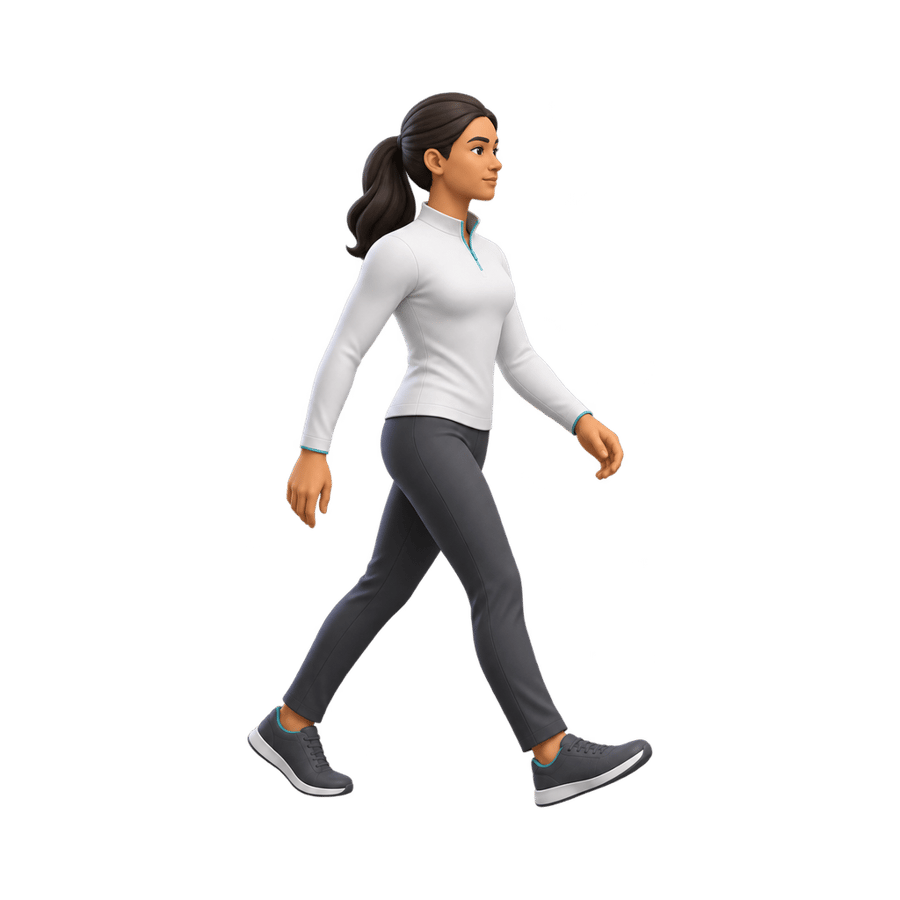
CDC’s shortcut works for any activity, not just walking. At moderate effort you can talk, but not sing. At vigorous effort you can’t say more than a few words without pausing for a breath. It also adjusts to you, which a step count can’t, since the same pace can be hard work for one person and easy for another.
Does pace matter for a long life?
Less than you’d think, once your total steps are counted. In 15 studies of 47,471 adults, the time people spent walking at 100 steps a minute or faster didn’t add a clear benefit on top of their daily total. Pace counts for the guideline’s 150 minutes and for fitness, and total steps count for the step curve. A brisk 30-minute walk adds to both, about 30 minutes and 3,000 steps.
3 sources
- Tudor-Locke C and others, Walking cadence (steps/min) and intensity in 21 to 40 year olds: CADENCE-adults, International Journal of Behavioral Nutrition and Physical Activity, 2019europepmc.org
- Centers for Disease Control and Prevention, Measuring physical activity intensitycdc.gov
- Paluch AE and others, Daily steps and all-cause mortality: a meta-analysis of 15 international cohorts, Lancet Public Health, 2022europepmc.org
