Walking isn't real exercise
Short answerNo
On this page
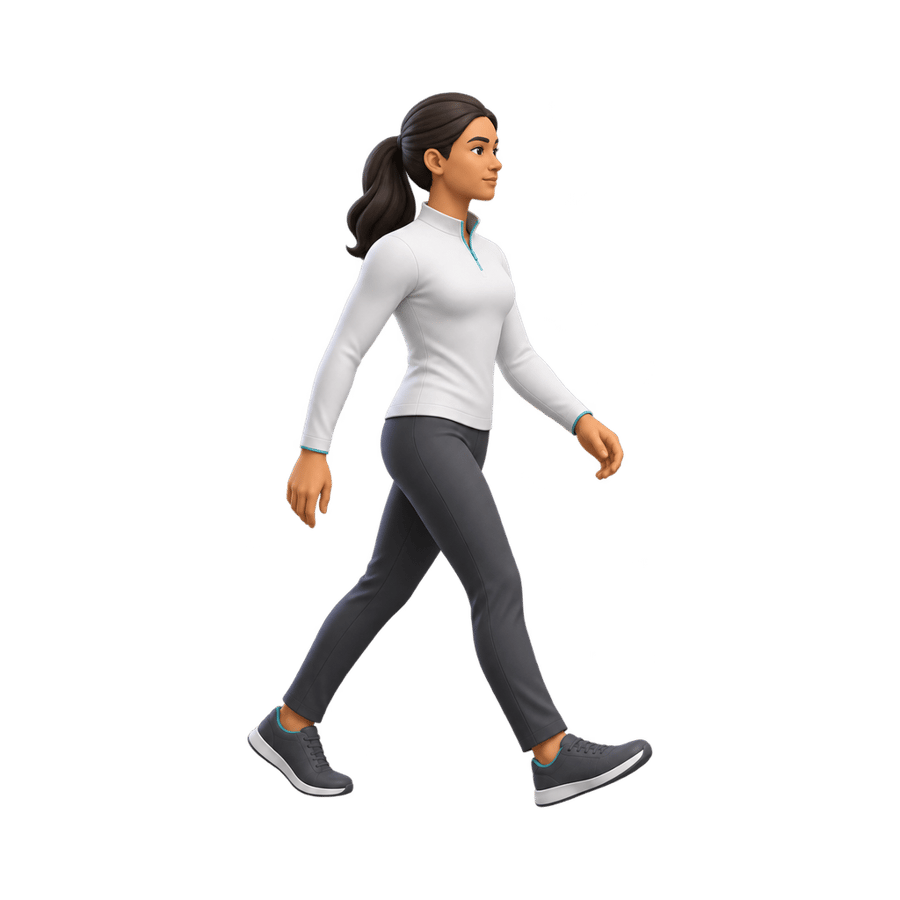
No. A brisk walk, at about 100 steps a minute or 2.5 miles an hour and up, is moderate exercise by the US guideline’s own measure, and every minute of it counts toward the 150. When adults around 63 walked fast in 3-minute intervals, their thighs got 13% stronger in five months.
What we’d do
Make walking the base of your week, and make it brisk, a pace where you can talk but not sing. Once that’s easy, make some of it harder with fast intervals or hills. Then add two short strength sessions, since walking covers the cardio half of the guideline and leaves the strength half to you.
If you remember three things
- Brisk walking is moderate exercise. The CDC lists walking at 2.5 mph or faster, and the guideline counts every minute.
- 100 steps a minute is the line. In a treadmill study, that pace was moderate effort 91.4% of the time.
- Fast walking builds legs and fitness. Interval walking raised thigh strength 13% to 17% and walking fitness 9% in adults around 63.
Why it sounds true
Walking is what you do anyway, to the car, around the store, down the hall. It doesn’t need special clothes, it rarely leaves you drenched, and nobody posts their stroll to the mailbox. Gym culture taught a lot of people that exercise is supposed to hurt, so anything this pleasant can’t count. And a slow stroll really doesn’t count toward the 150 minutes, which is where the myth gets its grain of truth.
What the guideline actually counts
The guideline counts effort, measured in METs, where sitting still is 1. The CDC puts moderate activity at 3 to 5.9 METs, and its first example is “walking briskly (2.5 miles per hour or faster)”. In a 2019 study of 76 adults aged 21 to 40 on a treadmill, walking at 100 steps a minute meant moderate effort (3 METs) 91.4% of the time, and 130 steps a minute was vigorous 70.7% of the time.
A 30-minute brisk walk is 30 of your 150 minutes, the same as 30 minutes of doubles tennis or a water aerobics class. Five of them is the whole cardio half of the US guideline. Count your steps for 15 seconds and multiply by 4 to check, or tap along in Is my walk brisk enough?
A picture from daily life
Saying walking isn’t real exercise is like saying a home-cooked dinner isn’t real food because it didn’t come from a restaurant. What feeds you is what’s on the plate, wherever it was made.
Your heart and lungs respond to the effort, and a brisk walk delivers it on a sidewalk instead of a treadmill.
What fast walking did in a trial
In 2004, researchers enrolled 246 adults, 60 men and 186 women with a mean age of 63, and split them into three groups for five months. One group did no training. Another walked at a moderate pace, aiming for 8,000 steps on four or more days a week. The third did interval walking: 3 minutes fast, above 70% of their walking capacity, then 3 minutes easy, at least five times through, on four or more days a week.
In the interval group, knee-straightening strength rose 13%, knee-bending strength 17%, aerobic capacity on a bike 8% and walking capacity 9%. The authors concluded it “may protect against age-associated increases in blood pressure and decreases in thigh muscle strength and peak aerobic capacity.” That’s the interval walk in today’s session.
What walking does across a lifetime
Walking is most of what people do in the big step studies. In a 2025 review of 57 studies, 7,000 steps a day against 2,000 went with 47% lower risk of death, 25% less heart disease and 38% less dementia. In the 2026 Harvard study of 147,374 US health professionals, enough aerobic activity with no lifting at all went with 26% lower risk of death than very little. How many steps do you need?
Where the myth has a point
- A slow stroll doesn’t count toward the 150. Under about 100 steps a minute, walking is light activity. It still helps your health, it just doesn’t add to the guideline’s minutes.
- Walking doesn’t do the strength half. It works your legs at a light load and leaves your arms, chest and back alone. Add two short strength sessions. Why lift if you already walk?
- For a higher fitness number, you’ll want harder efforts too. Fast intervals, hills or a jog are how walkers get fitter once brisk walking feels easy.
More detail: the walking bands
| Steps a minute | Effort | Counts toward the 150 |
|---|---|---|
| Under 100 | Light | No, but it still helps |
| 100 to 129 | Moderate | Yes, each minute |
| 130 and up | Probably vigorous | As moderate, or as two a minute if you can only say a few words |
The bands were set in adults 21 to 40, so after 60 the talk test is the better guide: you can talk, but not sing.
6 sources
- Centers for Disease Control and Prevention, Measuring physical activity intensitycdc.gov
- Tudor-Locke C and others, Walking cadence (steps/min) and intensity in 21 to 40 year olds: CADENCE-adults, International Journal of Behavioral Nutrition and Physical Activity, 2019europepmc.org
- Nemoto K and others, Effects of high-intensity interval walking training on physical fitness and blood pressure in middle-aged and older people, Mayo Clinic Proceedings, 2007europepmc.org
- US Department of Health and Human Services, Physical Activity Guidelines for Americans, 2nd edition, executive summary, 2018odphp.health.gov
- Ding D and others, Daily steps and health outcomes in adults: a systematic review and dose-response meta-analysis, Lancet Public Health, 2025europepmc.org
- Zhang Y and others, Long-term resistance training with all-cause and cause-specific mortality, British Journal of Sports Medicine, 2026pmc.ncbi.nlm.nih.gov