How much exercise do seniors need?
The same 150 brisk minutes and two strength days as younger adults, plus balance work. In 108 trials of people 60 and up living at home, exercise cut the rate of falls by 23%. That makes balance practice as much a part of the week as the walking.
Older adults often hear that they should take it easy, and families worry that exercise will cause the fall everyone is afraid of. Moving less feels safer. The trials found the opposite. Strength and balance fade when they aren’t used, and exercise aimed at them is one of the best-tested ways there is to prevent falls.
What we’d do
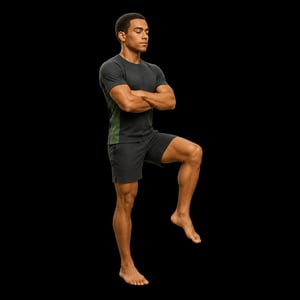
Walk most days, lift twice a week with every big muscle, and add a short balance set to most sessions, with heel-to-toe walking along a kitchen counter, one-foot holds with a hand near the counter and slow chair stands. Judge effort by how hard it feels to you. If 150 minutes is out of reach, do what your body allows, since some is better than none.
Balance works a lot like a language. Use it every day and it stays fluent. Leave it for a few years and it gets rusty, and practice brings it back.
What does the guideline ask for?
CDC’s advice for adults 65 and up:
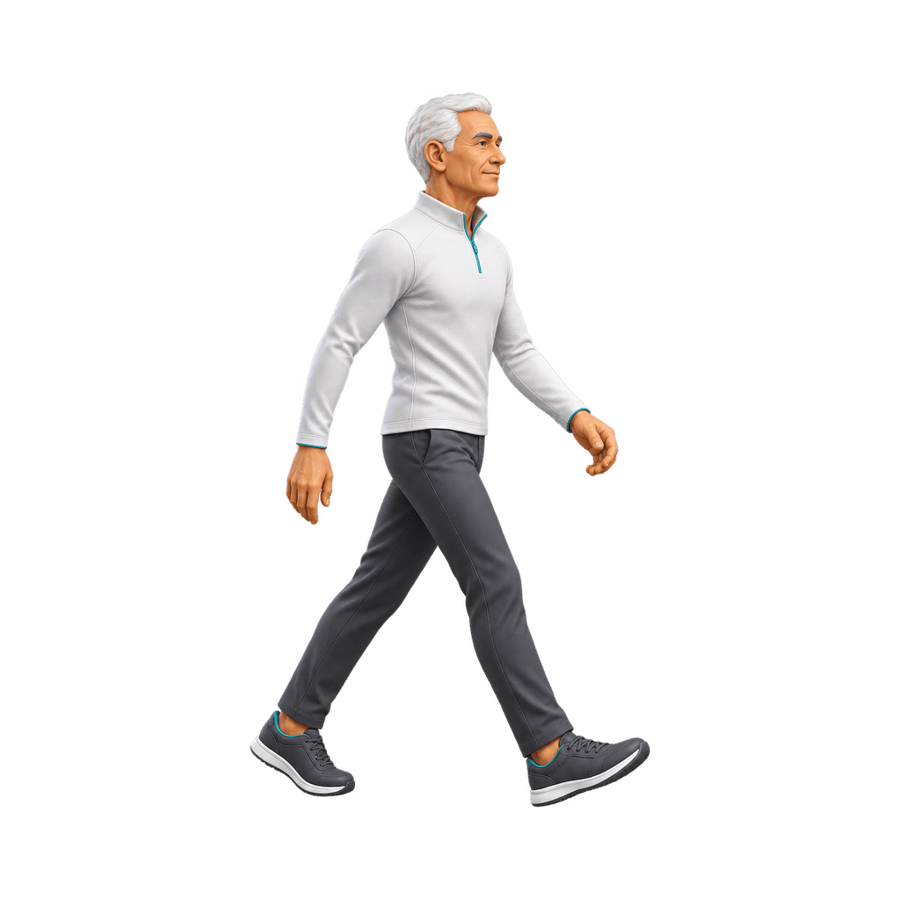
- Cardio. At least 150 minutes a week of moderate activity, which “could be 30 minutes a day, 5 days a week,” or 75 minutes of vigorous activity, or a mix.
- Strength. At least 2 days a week of activities that strengthen muscles.
- Balance. Activities that improve balance, like walking heel to toe or standing up from a chair.
The 2018 US guideline adds that older adults should set their effort “relative to their level of fitness.” Brisk for a fit 70-year-old and brisk for someone just starting are different speeds, and both count. People with chronic conditions should know how their condition affects exercise, and CDC says that anyone who can’t reach the full amount should be as active as their abilities and conditions allow.
Why balance?
In 2019, a Cochrane review pooled 108 trials with 23,407 people aged 60 and up living in their own homes, average age 76. Exercise cut the rate of falls by 23% and the number of people who fell by 15%, and the reviewers rated the evidence high. In a group where you’d expect 850 falls over a year for every 1,000 people, that’s about 195 fewer falls. At least a third of people over 65 living at home fall each year, so a cut that size reaches a lot of people.
Why strength?
Strength fades faster than muscle. In 1,880 people in their 70s, leg strength fell about three times faster than leg muscle over three years. A 2012 review put the loss at 75 at 3 to 4% of strength a year in men and 2.5 to 3% in women. Two strength sessions a week is how you slow it, and the chair stands in the balance set double as strength work for your legs.
One example week
| Day | What |
|---|---|
| Monday | Balance set, 20-minute brisk walk, strength circuit |
| Tuesday | 30-minute brisk walk |
| Wednesday | Balance set, 30-minute brisk walk |
| Thursday | Balance set, 20-minute brisk walk, strength circuit |
| Friday | 30-minute brisk walk |
| Saturday | Balance set, 20-minute brisk walk |
That’s 150 brisk minutes, two strength days and balance on four days. The balance set in Today’s session takes about 6 minutes, and for steps, the curve flattened at 6,000 to 8,000 a day in people 60 and up. The quiz builds a first week for your age and the chair stand count you can do now.
6 sources
- Centers for Disease Control and Prevention, Physical activity for older adultscdc.gov
- US Department of Health and Human Services, Physical Activity Guidelines for Americans, 2nd edition, executive summary, 2018odphp.health.gov
- Sherrington C and others, Exercise for preventing falls in older people living in the community, Cochrane Database of Systematic Reviews, 2019europepmc.org
- Goodpaster BH and others, The loss of skeletal muscle strength, mass, and quality in older adults: the Health, Aging and Body Composition Study, Journals of Gerontology, 2006europepmc.org
- Mitchell WK and others, Sarcopenia, dynapenia, and the impact of advancing age on human skeletal muscle size and strength, Frontiers in Physiology, 2012europepmc.org
- Paluch AE and others, Daily steps and all-cause mortality: a meta-analysis of 15 international cohorts, Lancet Public Health, 2022europepmc.org
