What counts as moderate exercise?
On this page
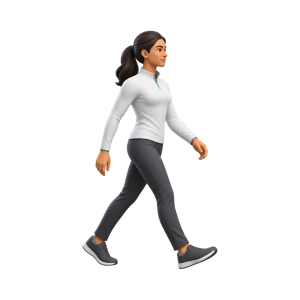
Anything that gets you breathing harder while you can still talk but not sing. Walking at 2.5 mph or faster counts, which is about 100 steps a minute, and so do easy cycling, water aerobics and yard work. Every minute counts toward the 150 a week, even in short bouts.
Moderate sounds like it should mean sweaty and a bit miserable, so people who walk the dog or mow the lawn assume it doesn’t count. Other people count everything, including a slow browse around the shops. The guideline means something specific in between, and you can check it in a few seconds without any device.
What we’d do
Use the talk test on your next walk. If you can sing, speed up until you can’t. If you can only get out a few words at a time, that’s vigorous, and it counts double. Do it once or twice and you’ll know what brisk feels like for the rest of your life.
What the talk test is checking
Scientists measure effort in METs, short for metabolic equivalents. One MET is what your body burns sitting still. CDC puts moderate activity at 3 to 5.9 METs and vigorous at 6 or more. Your body at rest is like a car idling at a light. Moderate is driving across town, and vigorous is merging onto the highway.
Nobody carries a lab around, so CDC gives a shortcut. At moderate effort you “can talk, but not sing.” At vigorous effort you can’t say more than a few words without pausing for a breath.
What’s on CDC’s moderate list?
- Walking briskly, 2.5 mph or faster
- Cycling slower than 10 mph on level ground
- Recreational swimming or water aerobics
- Doubles tennis
- Ballroom or line dancing
- General yard work and home repair
- Active yoga, like vinyasa or power yoga
The steps version
In 2019, Catrine Tudor-Locke’s team put 76 adults aged 21 to 40 on a treadmill, starting at half a mile an hour and speeding up every 5 minutes. Someone counted every step by hand while a mask measured how much oxygen each person used. At 100 steps a minute, people were at moderate effort 91.4% of the time.
That gives you a second test. Count your steps for 15 seconds and multiply by 4. If you get 100 or more, you’re there. The study only tested adults up to 40, so if you’re older, use the talk test alongside the count. Is my walk brisk enough? does the counting for you, with a beat to match.
Do short bouts count?
Yes. The first US guideline, in 2008, only counted activity done in stretches of at least 10 minutes. The 2018 edition dropped that rule, because the evidence showed small amounts of activity through the day help too. Its campaign for the public says, “Even 5 minutes of physical activity has real health benefits.”
A brisk 5-minute walk to the train, a fast flight of stairs and a 10-minute walk after lunch all go into the same weekly total. Add yours up in Your week.
4 sources
- Centers for Disease Control and Prevention, Measuring physical activity intensitycdc.gov
- Tudor-Locke C and others, Walking cadence (steps/min) and intensity in 21 to 40 year olds: CADENCE-adults, International Journal of Behavioral Nutrition and Physical Activity, 2019europepmc.org
- US Department of Health and Human Services, Physical Activity Guidelines for Americans, 2nd edition, executive summary, 2018odphp.health.gov
- US Office of Disease Prevention and Health Promotion, Top 10 things to know about the second edition of the Physical Activity Guidelines for Americansodphp.health.gov
