What do you do at the gym the first time?
On this page
Keep the first visit short and plain. Warm up for 10 minutes on a bike, an elliptical or a rowing machine at a pace where you can talk but not sing. Then do six moves for your big muscles, two sets each, with a weight you could lift a few more times. Finish in about 40 minutes, and book your next visit before you walk out.
The gym looks like a place with rules everyone else already knows. The machines have diagrams that make no sense, the free weight area seems to belong to people who’ve been coming for years, and the fear is that everyone will see you doing it wrong. People either stay away, or they go once, try every machine in the room, wake up too sore to walk the stairs and never go back. Both come from treating day one as a test of everything. It works better as a short tour with a light workout in it.
What we’d do
Go at a quiet hour, like mid-morning or after the evening rush, with this page on your phone. Do the warm-up, then the six moves in order, on machines or dumbbells, whichever is free. Use weights that feel easy for the first set and a bit harder for the second. Write down what you lifted. Before you leave, put the next visit in your calendar for two or three days later. The first visit is about learning where things are, and getting stronger starts on the second.
If you remember three things
- Two sets is enough. A review of 137 reviews found strength rose most with 2 to 3 sets, and the type of equipment made no consistent difference.
- Most new members don’t last. At one gym, 63% of new members had stopped by month three.
- The second visit decides it. Of 54 programs tested on gym members, the best one rewarded coming back after a miss.
What should you bring?
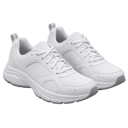
Shoes you can walk and squat in, a water bottle, a small towel, and your phone with the plan on it. That’s all. Ask for a quick tour when you sign up: where the dumbbells, the cardio machines and the six machines below are, and how the pins and seats adjust.
How do you warm up?
Ten minutes on any cardio machine, at a pace where you can talk but couldn’t sing, which is moderate effort by CDC’s talk test. Those minutes count toward your 150 brisk minutes for the week. Every machine in the cardio area can be easy or hard depending on the setting, so start low.
- Stationary bike, 50 watts, light Brisk
- Elliptical, moderate effort Brisk
- Rowing machine, under 100 watts Brisk
- Stationary bike, 70 to 80 watts Brisk
- Elliptical, vigorous effort Hard
- Stair machine, general Hard
METs, the energy of each machine against sitting still, from the 2024 Compendium of Physical Activities. CDC counts 3 to 5.9 as moderate and 6 or more as vigorous. For a warm-up, stay in the green.
The light bike and the moderate elliptical or rower are the warm-up. The stair machine and a hard elliptical are a workout of their own, so leave them for another day.
Which six moves?
One move for each big job your muscles do: a squat, a hinge, a push, a pull, a carry and a step. That covers every major muscle, which is what the US guideline asks of a strength day. Each has a machine version and a dumbbell version, so if one is taken you can use the other.
| The job | On a machine | With dumbbells |
|---|---|---|
| Squat | Leg press | Goblet squats |
| Hinge | Back extension bench | Romanian deadlifts |
| Push | Chest press | Floor presses |
| Pull | Seated row or lat pulldown | One-arm rows |
| Carry | None, use dumbbells | Farmer carries |
| Step | Step-up box | Step-ups |
The dumbbell column is the same circuit the session player uses with weights, so you can do the identical workout at home on the days you don’t go. strength.guide has the full program, how to start lifting weights, and how many sets and reps to work toward.
How heavy, and how many?
Two sets of each move. For the first set, pick a weight you could lift 12 or more times and do about 10. For the second, go a little heavier, so the last two or three reps feel hard but your form stays clean. Stop there. Going until you can’t lift it again didn’t consistently make people stronger in the big review below.
Rest a minute or two between sets. Write down each weight on your phone, because next time you’ll want to know where to start. Across 137 reviews of more than 30,000 people, strength rose most with 2 to 3 sets, heavier loads over time and at least 2 sessions a week. Day one is the light end of that.
What if it’s busy?
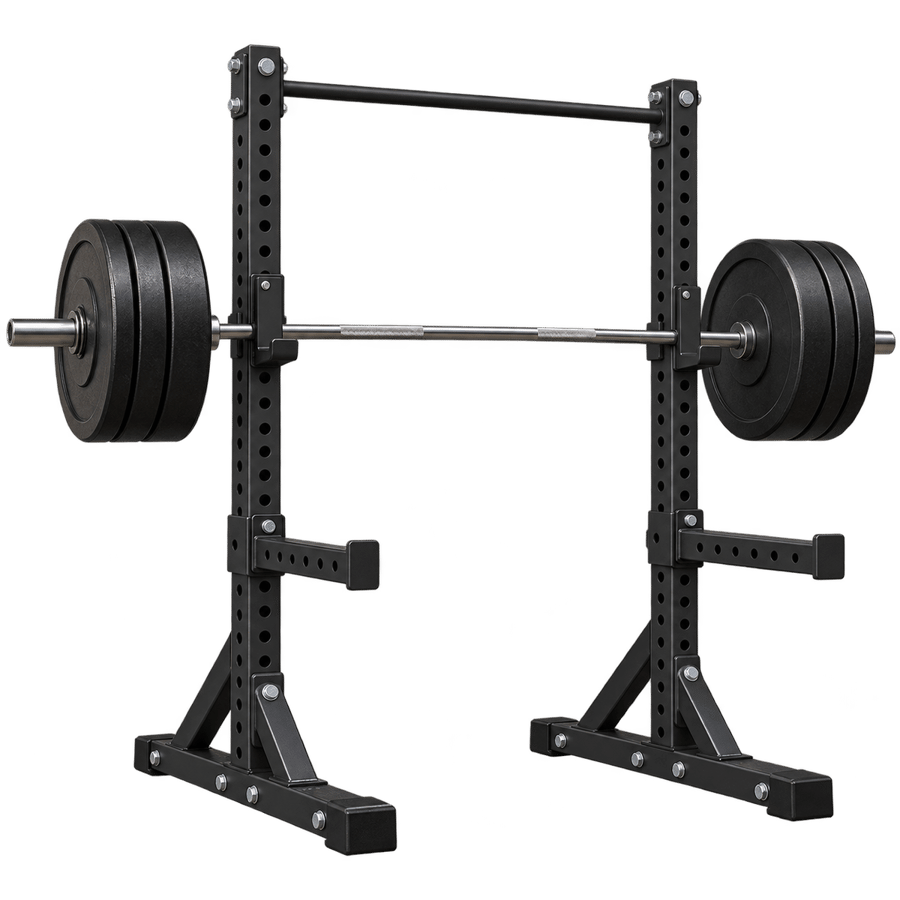
Swap to the other column. If the leg press is taken, do goblet squats with a dumbbell. If every bench is full, do the rows with one hand on a dumbbell rack. You can also ask someone if you can share a machine between their sets. Leave the squat rack and the barbell for later, unless a trainer shows you how. A full workout doesn’t need either.
A picture from daily life
Think of your first day at a new job. Nobody expects you to know every system by lunch. You find your desk, the coffee and one person you can ask, and on the second day you’re already faster. By the end of the month you’re the one showing someone else where things are.
The first gym visit is that first day. Learn where six things are and how they adjust, lift something light on each, and go home. The real work starts when you come back.
How do you make sure you come back?
Plan for the part where most people stop. In one fitness center that tracked 5,240 new members over a year, 63% had stopped coming before their third month, and under 4% were still going after twelve. That was one gym in Rio de Janeiro, so the exact numbers won’t hold everywhere, but the shape of it is the problem to plan for.
What helps is making the comeback easy. In a 2021 study of 61,293 members of a US gym chain, 30 scientists tested 54 different four-week programs to get people to the gym. About 45% of them raised weekly visits, by 9% to 27%. The best one gave small rewards for coming back after a missed workout, so book the next session before you leave, and if you miss it, go to the one after. How do you keep exercising after the first month?
27%
More gym visits from the best of 54 programs, which rewarded the comeback after a miss
Machines or dumbbells?
The case for machines
Less to learn on day one. A machine guides the path, the weight changes with one pin, and the diagram shows the muscle it works. For someone nervous about doing it wrong, that’s a lot of worry taken away.
The case for dumbbells
The same moves work at home. Goblet squats and rows need nothing but a weight, so the workout travels. The big review found equipment type made no consistent difference to strength, so use whichever gets you through the six moves.
7 sources
- Currier BS and others, American College of Sports Medicine position stand: resistance training prescription for muscle function, hypertrophy, and physical performance in healthy adults, an overview of reviews, Medicine and Science in Sports and Exercise, 2026europepmc.org
- Herrmann SD and others, 2024 Adult Compendium of Physical Activities: a third update of the energy costs of human activities, Journal of Sport and Health Science, 2024europepmc.org
- Compendium of Physical Activities, conditioning exercise and bicycling codespacompendium.com
- Centers for Disease Control and Prevention, Measuring physical activity intensitycdc.gov
- Sperandei S, Vieira MC and Reis AC, Adherence to physical activity in an unsupervised setting: explanatory variables for high attrition rates among fitness center members, Journal of Science and Medicine in Sport, 2016europepmc.org
- Milkman KL and others, Megastudies improve the impact of applied behavioural science, Nature, 2021europepmc.org
- US Department of Health and Human Services, Physical Activity Guidelines for Americans, 2nd edition, executive summary, 2018odphp.health.gov
