How do you get fit on a bike, indoors and out?
On this page
Ride at a pace where you can talk but not sing, and count every minute toward your week. On flat ground the CDC counts riding under 10 mph as moderate and anything faster as vigorous. Once a week, make a ride hard with a few short sprints, which a stationary bike makes easy. Ride to work if you can, wear a helmet, and lift weights too, because a bike does little for your bones.
People tend to think about cycling in one of two ways. Either it’s the serious kind, with clip-in shoes and 50-mile Sunday rides, or it’s a gentle pedal that barely counts. Most riding sits in between, and it’s some of the most useful exercise there is, since you can do a lot of it without pounding your knees and it gets you places. The catch is that a bike makes it easy to coast, so you have to know what effort you’re at.
What we’d do
Ride three or more times a week at a steady talk-but-not-sing effort, outdoors or on a stationary bike, whichever you’ll really do. If you can ride to work or to the shops, do that, since those minutes count. Once a week, warm up and then do three 20-second sprints, as hard as you can, with two easy minutes between. Always wear a helmet on the road. And lift twice a week, since cycling doesn’t do the job for your bones.
If you remember three things
- Speed decides whether it’s brisk or hard. The CDC counts cycling under 10 mph on the flat as moderate and 10 mph or faster as vigorous, where every minute counts as two.
- Riding to work went with lower risk. In 263,450 UK commuters, people who cycled to work had 41% lower risk of death than people who drove or took the bus.
- Short and hard works too. 3 sprints of 20 seconds in a 10-minute session raised fitness as much as 50 minutes of steady riding in a 12-week trial.
How hard is a bike ride?
The CDC uses speed. “Bicycling slower than 10 miles per hour on level terrain” is moderate, and “bicycling faster than 10 miles per hour” is vigorous. Hills, wind and a heavy bike move that line, so the talk test is still the better guide on any given day.
The Compendium of Physical Activities measures how hard things are in METs, the energy of an activity against sitting still. Here’s where cycling falls in its 2024 edition.
- E-bike, high assist Brisk
- Easy pace, own choice Brisk
- Leisure, 9.4 mph Brisk
- E-bike, light assist Hard
- Stationary bike, general Hard
- Commuting, own pace Hard
- 12 to 13.9 mph Hard
- 14 to 15.9 mph Hard
METs: the energy of the activity against sitting still. CDC counts 3 to 5.9 as moderate and 6 or more as vigorous. Values from the 2024 Compendium of Physical Activities, measured in adults 19 to 59.
A leisurely 9.4 mph ride is 5.8 METs, comfortably brisk. A general session on a stationary bike is 6.8, and riding to work at your own pace is 6.8, both into the range where a minute counts as two. Even an e-bike with high assist, the setting where the motor does most of the work, is 4 METs, still inside the moderate band. On light assist it’s 6.
Does riding to work count?
It counts, and it looked like one of the best ways to get your minutes. In 2017, researchers followed 263,450 UK adults for about 5 years and compared how they got to work. People who cycled had 41% lower risk of dying from any cause than people who drove or took public transport, and lower rates of heart disease and cancer too.
In a separate study of 80,306 British adults, people who cycled for exercise had 15% lower risk of death than people who didn’t. Both studies followed people who chose to cycle, so part of the difference may come from the kind of people who ride. But a commute has a big advantage over a gym session: you do it whether you feel like it or not.
19%
rise in fitness after 12 weeks, from 10-minute sprint sessions and 50-minute steady ones alike
69%
lower odds of a serious head injury with a helmet, in a crash or a fall
What should you do on a stationary bike?
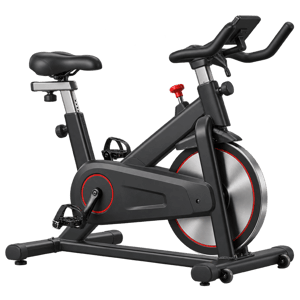
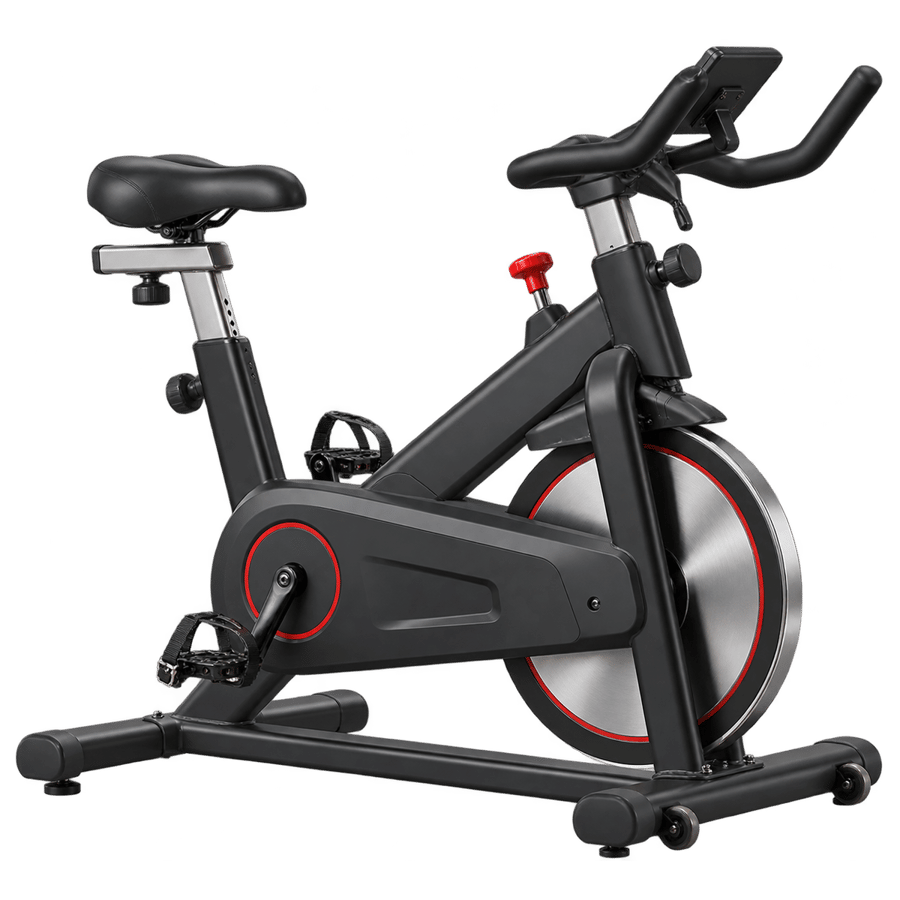
Most indoor riding is steady, and that’s fine. A stationary bike also happens to be the best tool for short hard efforts, because there’s no traffic, no hill to find and nothing to fall off.
In 2016, researchers put sedentary men on bikes three times a week for 12 weeks. One group rode 45 minutes at a steady pace, which with the warm-up and cool-down made a 50-minute session. The other group did 3 all-out sprints of 20 seconds, with two minutes of easy pedaling between them, in a 10-minute session. Their fitness (peak oxygen uptake) rose by 19% in both groups. The sprint group did about a fifth of the exercise, and the groups were small, but it shows how much a few hard seconds can do.
Easy Hard Warm-up and cool-down
The sprint session is the one from the 2016 trial. The steady ride is a typical one.
The sprints really are all-out, the kind you can’t hold for long, so they’re for people who are already riding comfortably and have no heart symptoms. Steady or intervals? has gentler interval patterns to start with.
A picture from daily life
A bike is like a car with a gearbox. Low gear on a flat road, you can cruise for an hour and chat the whole way. Put it in a big gear up a hill and the engine roars within a minute. You choose how hard the ride is every few seconds, which is why the same bike can give you an easy recovery spin on Tuesday and the hardest 20 seconds of your week on Thursday.
Is an e-bike cheating?
The case for e-bikes
It still counts. Even on high assist an e-bike ride is 4 METs, inside the brisk band, and on light assist it’s 6. If the motor gets you riding to work instead of driving, you’re getting minutes you wouldn’t have had.
The case against
The motor takes some of the work. A regular commute at your own pace is 6.8 METs, more than an e-bike on high assist. If you have the legs for an ordinary bike, it gives you more for the same time.
We’d ride whichever bike gets you out the door most days, and turn the assist down as the hills get easier.
Do you need a helmet?
Yes, every time you ride on the road. In a 2017 review covering over 64,000 injured cyclists, wearing a helmet in a crash or a fall went with 51% lower odds of a head injury, 69% lower odds of a serious one and 65% lower odds of a fatal head injury. A stationary bike is the one place you can skip it.
Does cycling build strong bones?
It doesn’t do much for them. A 2012 review of 31 studies found that road cycling doesn’t seem to build bone, and that adult road cyclists who trained a lot had low bone density in places like the lower spine. The likely reason is that the bike holds your weight, so your bones don’t get the loading they get from walking, running or lifting. Mountain biking and mixing cycling with other sports looked better. If cycling is your main exercise, lifting twice a week covers what the bike misses (how to get stronger bones on strength.guide).
What we still don’t know
The commuting and sport studies followed people who chose to ride, so they show lower risk in groups and can’t promise anything to one person. The sprint trial was small and only in men. And nobody has measured whether indoor and outdoor riding differ for health at the same effort. For most people, the answer is to ride the one that fits their week.
7 sources
- Centers for Disease Control and Prevention, Measuring physical activity intensitycdc.gov
- Herrmann SD and others, 2024 Adult Compendium of Physical Activities: a third update of the energy costs of human activities, Journal of Sport and Health Science, 2024, https://europepmc.org/article/MED/38242596 (values frompacompendium.com
- Celis-Morales CA and others, Association between active commuting and incident cardiovascular disease, cancer, and mortality: prospective cohort study, BMJ, 2017europepmc.org
- Oja P and others, Associations of specific types of sports and exercise with all-cause and cardiovascular-disease mortality: a cohort study of 80 306 British adults, British Journal of Sports Medicine, 2017europepmc.org
- Gillen JB and others, Twelve weeks of sprint interval training improves indices of cardiometabolic health similar to traditional endurance training despite a five-fold lower exercise volume and time commitment, PLoS One, 2016europepmc.org
- Olivier J and Creighton P, Bicycle injuries and helmet use: a systematic review and meta-analysis, International Journal of Epidemiology, 2017europepmc.org
- Olmedillas H and others, Cycling and bone health: a systematic review, BMC Medicine, 2012europepmc.org
